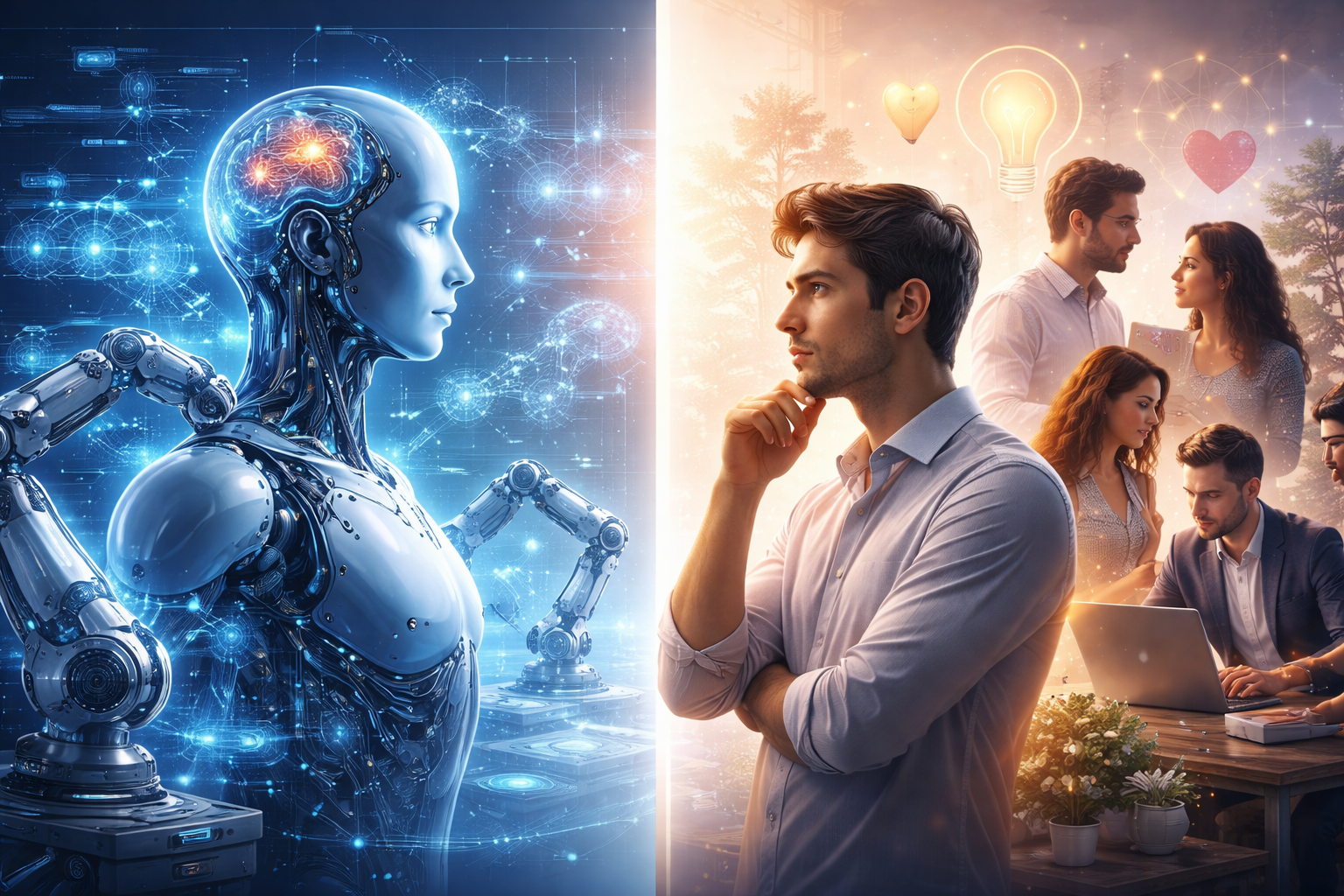
Artificial Intelligence (AI) is one of the most important new technologies of the 21st century. It has an effect on many fields, including transportation, finance, healthcare, and education. AI could change the way we work, come up with new ideas, and get things done faster, but it also comes with problems and dangers that we need to be aware of. Businesses, policymakers, and people who want to use artificial intelligence responsibly need to look at both the pros and cons of the technology.
AI stands for machines or computer systems that are made to work like people. These systems can do things that normally require people to think, like making decisions, learning, solving problems, and even understanding language. AI is used a lot these days for specific tasks, like virtual assistants, recommendation engines, and automated data analysis. More advanced types of AI, like general AI and superintelligent AI, are mostly still ideas, but they could be very useful in the future. Knowing what AI can and can’t do helps us figure out what its pros and cons are.
Learning about AI
Artificial intelligence is the process of teaching machines to think and act like people. AI systems can look at data, learn from it, and get better over time, while traditional software can only do the same tasks over and over again. There are three main types of AI. The most common type of AI today is narrow AI, which focuses on specific tasks. General AI refers to systems that can do any intellectual task that a person can do. Superintelligent AI, which is still just a theory, would be smarter and better at things than people.
AI is useful in many different ways, which shows how flexible it is. It runs virtual assistants like Siri and Alexa, powers recommendation algorithms on sites like Netflix and Amazon, and even helps doctors figure out what’s wrong with patients. To understand the pros and cons of AI, you need to know what kinds of AI there are and how they are used.
Benefits of AI
Increasing Productivity and Efficiency
One of the best things about AI is that it can make things more efficient and productive. AI can do tasks that are boring and take a long time to do faster and more accurately than people can. AI-powered robots can put together products in a precise and consistent way in factories. AI systems take care of data entry, scheduling, and document processing in offices, giving workers more time to focus on important tasks. AI boosts overall productivity by cutting down on mistakes and speeding up processes. This lets businesses do more in less time.
Cutting down on operational costs
AI can also help cut costs over time. It costs money to set up AI, including buying hardware, software, and training, but in the long run, it saves money by automating tasks that take a lot of time and effort. AI can find unusual financial patterns, cut down on energy use, and make supply chains work better, all of which can save a lot of money over time. Companies that use AI well can save money and improve their operations at the same time.
Always Available
AI systems can work nonstop without breaks or downtime, unlike people. Chatbots, customer service platforms, and automated monitoring systems are always on, so they can keep an eye on things and provide service. AI is a reliable solution for industries where operations must not stop, like healthcare or transportation. This constant availability improves the quality of service and makes sure that important tasks are never late.
Correctly analyzing data
AI is very good at handling and analyzing huge amounts of data. It can find patterns, trends, and outliers that people might miss, which helps people make smart choices. For instance, AI in healthcare can find early signs of diseases, and AI in finance can use past data to guess what will happen in the future. AI-driven analysis helps businesses make better choices, cut down on mistakes, and get the best results by being more accurate and faster.
Helping new ideas grow
AI drives innovation in many fields. AI has made self-driving cars and better traffic management systems possible in transportation. AI-powered diagnostic tools in healthcare help patients get better treatment. AI-powered learning platforms in schools make learning more personal for each student. AI speeds up progress and helps society solve hard problems by making it easier to try new things and come up with new ideas.
Making things safer and more accurate
AI makes important tasks safer and more accurate. In factories, robots do dangerous jobs that could put people’s lives in danger. AI makes navigation more accurate in planes and self-driving cars, and it cuts down on accidents that happen because of human error. AI’s accuracy in dangerous or repetitive tasks leads to better results and keeps people safe.
Disadvantages of Artificial Intelligence: High Costs of Implementation
Artificial intelligence has its pros and cons. The high cost of putting it into action is a big problem. To build or buy AI systems, you need to spend a lot of money on technology and training. These financial barriers may make it hard for smaller businesses to compete. Some organizations may not be able to fully use AI’s potential if they don’t have the right resources.
Job Loss and Problems with the Workforce
Automation powered by AI can take over jobs in fields that depend on repetitive, manual work. Jobs in manufacturing, customer service, and administration are especially at risk. AI creates new jobs in tech and AI management, but it can be hard for workers whose skills are no longer in demand to make the switch. To deal with these problems, we need programs to help workers learn new skills and retrain them.
Not being creative or emotionally smart
Artificial intelligence can analyze things, but it can’t really be creative or understand emotions. AI can write music, come up with ideas, or suggest solutions, but it can’t copy how people think, feel, or empathize. Industries that depend on creativity, emotional intelligence, or complicated human interaction can’t rely only on AI. Humans are still important in situations that call for judgment, compassion, and new ideas.
Risks to Data Privacy and Security
AI systems depend on data a lot, and this data often includes private information about people or businesses. Privacy violations and security threats can happen if things are not handled properly or if there are breaches. AI applications in healthcare or finance, for example, deal with private information, and if they have security holes, that information could be stolen or used in the wrong way. To reduce these risks, it is important to have good data governance and cybersecurity.
Too much reliance on technology
Too much reliance on AI can make people less able to think critically and solve problems. When AI systems break down or stop working, companies that rely too much on them may have problems with their operations. To avoid becoming too dependent on AI, it’s important to find a balance between human oversight and AI automation.
Concerns about ethics
AI also brings up a lot of moral questions. Algorithms can show human biases, which can lead to unfair or discriminatory results. To make sure that AI is fair and accountable, we need to keep an eye on its decisions about hiring, lending, and law enforcement. As AI becomes more common, society needs to figure out how to hold AI systems accountable for their mistakes in a way that is both legal and moral.
Uses of AI
In almost every field, people use artificial intelligence. AI helps doctors figure out what diseases people have, keep an eye on their health, and guess how well treatments will work. AI-powered personalized learning platforms that change to fit each student’s pace are good for education.It looks at how people act as customers, automates tasks, and makes it easier for businesses to connect with customers. AI has an effect on transportation in the form of self-driving cars, better traffic management, and more efficient logistics. It predicts market trends, finds fraud, and automates trading in the finance world. AI helps manufacturing by making production more efficient, cutting down on mistakes, and making things safer. These examples show how AI can be both helpful and harmful in real life.
How AI affects everyday life
AI has a lot of effects on everyday life. Siri, Alexa, and Google Assistant are examples of virtual assistants that make things like reminders, navigation, and entertainment easier. Recommendation systems on streaming sites make content more personal, which improves the user experience. Smart home devices help save energy, make homes safer, and make life easier. AI-powered wearable devices keep track of health metrics in real time, even in healthcare, so that people can get preventive care. AI’s incorporation into everyday life illustrates its advantages and the necessity for prudent utilization.
The Future of AI
There will be many good and bad things that happen with AI in the future. In the future, cities will be smarter because their infrastructure will be managed by AI, healthcare will be better, and people and machines will work together better. AI is expected to make better use of energy, traffic systems, and personalized education. But it is still very important to deal with ethical issues, keep data safe, and handle changes in the workforce. Society can use AI safely and responsibly if it knows the pros and cons of AI.
Questions and Answers About the Pros and Cons of AI
What are the most important benefits of AI?
Artificial intelligence makes things more efficient, lowers operating costs, works all the time, makes data analysis better, drives innovation, and makes important tasks more accurate.
What are the bad things about AI?
AI can be expensive to implement, can take jobs away from people, can raise ethical questions, can put data privacy at risk, can make people too reliant on technology, and can be less creative and emotionally intelligent.
How does AI affect our daily lives?
Virtual assistants, smart home devices, recommendation systems, wearable health monitors, and automated customer support are all examples of AI that makes tasks faster and easier.
Is it possible for AI to take over all human jobs?
No, AI can’t completely replace people because it doesn’t have creativity, intuition, emotional intelligence, or the ability to make moral decisions. People are still needed to make decisions and come up with new ideas.
Is AI safe for the future?
If AI is used responsibly, with ethical rules, good security, human oversight, and regular checks to make sure it isn’t being misused, it can be safe.
Which fields get the most out of AI?
AI is very helpful in healthcare, education, finance, transportation, manufacturing, and business analytics because it is efficient, can handle large amounts of data, and can automate complicated tasks.
How can companies use AI and still have enough workers?
Businesses can balance the use of AI by teaching employees new skills, using AI to help people do their jobs instead of replacing them, and making sure that AI is used in a fair and open way.
Final Thoughts
AI is changing the world in ways that have never happened before. The pros and cons of AI give a fair view of this game-changing technology. AI has many amazing benefits, such as making things more efficient, saving money, being available 24/7, analyzing data accurately, coming up with new ideas, and making things safer. But it also has problems, such as high costs of implementation, job loss, a lack of creativity, worries about data privacy, too much reliance, and moral issues.
People, businesses, and governments can use AI responsibly if they know what its pros and cons are. By using AI’s strengths and fixing its weaknesses, society can get the most out of AI technology to boost productivity, improve quality of life, and spark new ideas, all while protecting ethical standards and minimizing risks. When used wisely, artificial intelligence is a powerful tool for making the future smarter, more efficient, and more creative.