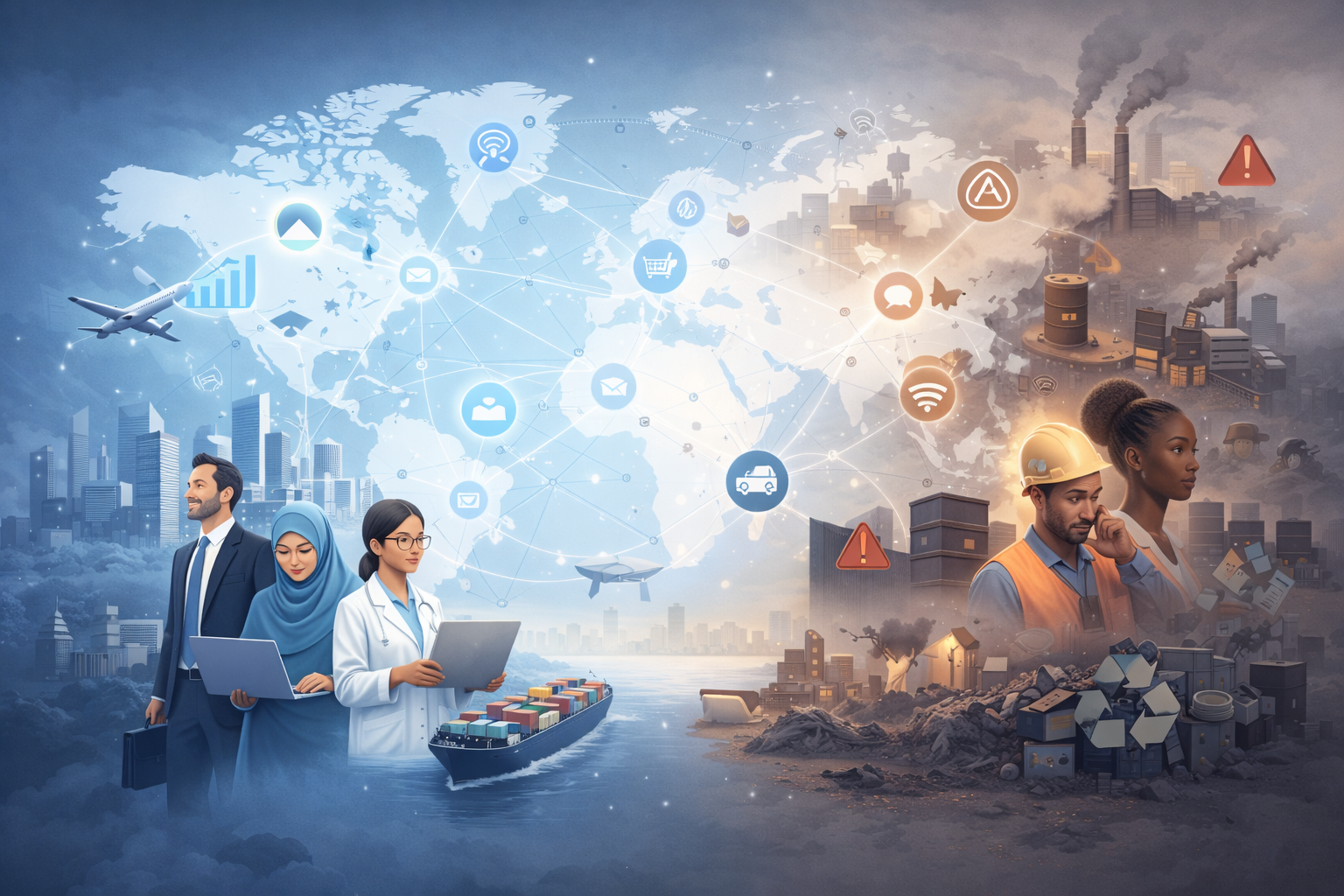
One of the most important things that has changed the world today is globalization. It affects the way people talk to each other, how countries trade, how cultures get along, and how economies grow. No country can stay completely alone in today’s world, where everything is connected. Things like goods, services, ideas, technology, and information are moving across borders faster than ever before. Because of this deep connection, it is important for students, teachers, policymakers, businesses, and society as a whole to understand the pros and cons of globalization.
This article talks about globalization in a thorough and purely informational way. The language is kept simple, professional, and clear so that everyone can understand it. To keep the academic quality, the content is organized with the right headings and mostly written in paragraphs without bullet points. The goal is to give a fair view that follows Google’s ranking rules and modern SEO standards.
Getting to Know the Idea of Globalization
Globalization is the process by which countries and societies become more connected and rely on each other. International trade, foreign investment, the exchange of technology, migration, and cultural interaction all help to make this connection. Globalization has made the world feel smaller over time by making it easier to communicate and travel quickly.
Globalization has grown in stages over time. People traded goods and ideas along early trade routes that linked civilizations. Later, industrialization made trade networks around the world bigger. In the modern era, digital technology has sped up globalization even more by making it possible for people to talk to each other and work together in real time. It is important to realize how deeply globalization is a part of everyday life in order to understand its good and bad effects.
The main things that are making globalization happen
There are many things that are making globalization grow. One of the most important factors is how technology is changing. New developments in digital platforms, information technology, and communication tools have made it easier for people and businesses to talk to each other around the world. Businesses can run operations in more than one country, and people can get information from all over the world right away.
Policies about the economy are also very important. Countries are more likely to do business with each other when trade is free, tariffs are lower, and there are international trade agreements. Transportation systems like air freight and container shipping also help goods and people move smoothly. These things work together to make the world more connected and change the overall effects of globalization.
The Economic Benefits of Globalization
Economic growth is one of the most well-known effects of globalization. Globalization lets businesses grow beyond their own countries by opening up markets and encouraging competition. Companies can reach more customers, which leads to more production and sales. This growth helps the economy grow and opens up new ways to be creative.
Another big benefit is foreign direct investment. Multinational companies put money into different countries, bringing with them money, advanced technology, and management skills. These investments often help host countries’ infrastructure, productivity, and skill development. Because of this, globalization helps raise the standard of living in many places.
Workforce Development and Employment
Globalization has an effect on how people work around the world. It makes jobs available in fields related to trade, technology, and services with other countries. Workers learn about global standards, new ways of doing things, and advanced skills, all of which help them grow professionally.
But the effects on jobs are different in different areas and industries. Some industries are growing, but others are having to change because of competition from around the world. To look at the pros and cons of globalization, you need to understand these changes, especially when it comes to how the workforce adapts and learns new skills.
The effect of globalization on education
Globalization has changed education in many important ways. Students now have access to online learning platforms, international academic resources, and research networks around the world. Universities work together across borders to encourage new ideas and the sharing of information.
Students can learn about different cultures and education systems through study abroad programs and academic exchanges. These chances help students get ready for jobs around the world and help them understand people from other cultures. As education becomes more global, people learn skills that are useful in a world where everything is connected.
Cultural Exchange and Integration into Society
Globalization makes it easier for people from different cultures to interact by letting them share their traditions, values, and ways of life. Learning about other cultures helps people be more tolerant, respect each other, and be aware of the world. Travel, the media, and digital communication are all important ways that cultural influences get across borders.
At the same time, cultural exchange around the world encourages new ideas in art, music, books, and other forms of entertainment. Societies adapt and mix cultural elements to make new ways to express themselves that show how different the world is.
Advancement and innovation in technology
Technology and globalization are very closely linked. Companies are pushed to come up with new ideas and use new technologies because of competition around the world. International collaboration helps research and development, which speeds up scientific progress.
Digital globalization lets people and businesses work from different places and lets people work from home. This change has changed whole industries and made it easier for people to get involved in the global economy.
Negative Economic Consequences of Globalization
Even though globalization has its benefits, it also causes problems for the economy. One of the biggest problems is income inequality. Highly skilled workers and developed areas often have more advantages, while less skilled workers may have a hard time competing.
When companies move production to countries where labor is cheaper, jobs can be lost. Even though new jobs may open up in other places, it can be hard for workers who are affected to make the switch. When looking at the pros and cons of globalization, these problems show how important it is to have policies that support inclusive growth.
Cultural and Social Problems
Globalization can put stress on local traditions and cultures. Global cultures that are more powerful than others can make local cultures less important, which can lead to cultural homogenization. As global trends become more important, smaller languages and traditional ways of doing things may fade away.
When societies have to deal with change quickly, social tensions can also happen. Conflicts between generations or cultures can happen when people have different values and ways of life. To deal with these problems, you need to be aware of other cultures and respect their differences.
The Effects of Globalization on the Environment
The environmental effects of globalization are a big worry for people all over the world. More industrial production and international shipping cause pollution, resource depletion, and climate change. As people around the world use more things, the need for natural resources grows.
But globalization also makes it possible for countries to work together to protect the environment. Countries work together to solve global environmental problems by sharing information, technology, and policies. Global partnerships are doing more and more to promote green innovation and sustainable practices.
Globalization in Developing Nations
Globalization affects developing countries in a different way than it does developed countries. Being able to trade with other countries and get money from them can help the economy grow and lower poverty. There are chances for progress in technology transfer and industrial development.
Weak rules can also put developing countries at risk of being taken advantage of and hurting the environment. For development to be sustainable, it is important to find a balance between growth and protecting people and the environment.
The Role of Governments and Institutions
Governments are very important in deciding how globalization will turn out. Good schools help workers deal with competition from around the world. Environmental rules cut down on damage to the environment, and labor laws protect workers’ rights.
International organizations help people work together and set rules that govern social and economic interactions around the world. Strong governance makes sure that the benefits of globalization are shared more fairly.
The Future of Globalization
As technology improves and politics change, globalization keeps changing. Digital trade, working from home, and global networks of innovation are all changing the way globalization works. Economic uncertainty and geopolitical problems also make it harder for countries to work together.
How societies deal with inequality, sustainability, and cultural diversity will determine the future of globalization. Globalization will only stay a good thing if we make smart decisions and work together with other countries.
A Look at Globalization as a Whole
To give a fair assessment of globalization, we need to look at both the good and the bad. Economic growth, education, innovation, and cultural exchange are all big benefits. Inequality, environmental issues, and cultural pressures all show how important it is to manage things responsibly.
When societies know the good and bad effects of globalization, they can make smart choices and come up with plans that get the most benefits while lowering the risks.
Questions that people ask a lot
In simple terms, what is globalization?
Globalization is when trade, technology, communication, and cultural exchange make countries and people more connected.
Why is globalization significant?
Globalization is important because it helps the economy grow, people share knowledge, new ideas are born, and countries work together.
What are the biggest problems with globalization?
The main problems are unequal income, job loss, environmental problems, and cultural pressure.
How does globalization affect students?
Globalization gives students the chance to study abroad, learn online, and find jobs all over the world.
Is it possible to control the effects of globalization?
Yes, strong policies, education, regulation, and working together with other countries can help control the effects of globalization.
Final Thoughts
Globalization is a complicated and strong process that affects how people live today. It links people, cultures, and economies all over the world. It has many benefits for growth, knowledge, and new ideas, but it also comes with problems that need to be handled carefully.
By making policies that include everyone, putting money into education, and encouraging sustainability, societies can make sure that globalization helps long-term growth. To build a balanced and connected future, we need to know what globalization does that is good and bad.