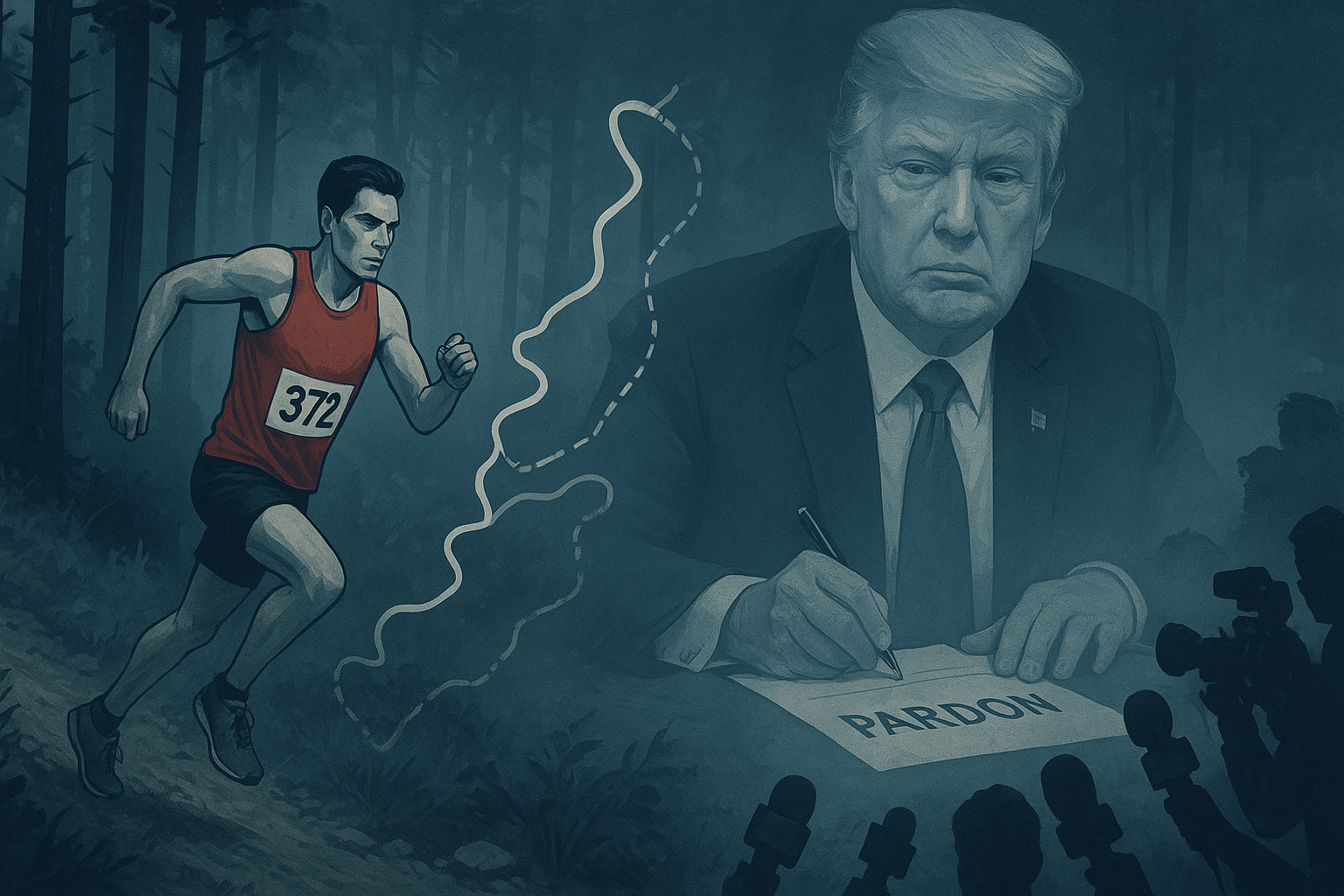
“Trump pardons trail runner for illegal shortcut”in this article we discuss about it.Former President Donald Trump gave Michelino Sunseri a presidential pardon. Sunseri is a trail runner who was facing federal charges for taking what authorities called a “illegal shortcut” during a record-breaking run in Wyoming’s Grand Teton National Park. This move has sparked praise and debate across the country.
The phrase “Trump pardons trail runner for illegal shortcut” is now making headlines for this event, which includes elements of sportsmanship, environmental regulation, and politics. It is a story that is both symbolic and controversial.
The Run That Started It All
In early September 2024, 28-year-old Idaho runner Michelino Sunseri tried to set a Fastest Known Time (FKT) on the Grand Teton trail. This is a very hard 13.2-mile climb and descent that tests athletes’ endurance to the max.
Sunseri did it in only 2 hours and 50 minutes, which was a few minutes faster than the previous record. The ultrarunning community was excited about the performance until park rangers found a problem. There were clear signs in the area that said “Trail Closed for Regrowth” and “Short Cutting Causes Erosion.”
From a record-breaking run to criminal charges
The National Park Service (NPS) and the U.S. Attorney’s Office charged Sunseri with violating Title 36, Code of Federal Regulations, Section 2.1(b), which says that people can’t enter or use closed areas in national parks. They did this after looking at GPS data and photos that were shared online.
What started out as a small trail violation quickly grew into a federal misdemeanor case with possible jail time of up to six months and a $5,000 fine.
At first, the prosecutors offered a plea deal that included community service and a course on ethics in the wilderness. Sunseri, on the other hand, decided to fight the charge, saying that the signs weren’t clear and that his shortcut didn’t hurt the environment.
His defense team, with help from the Pacific Legal Foundation, said that the government’s actions were “an overreach of environmental enforcement” and that making a small change in route illegal was too harsh.
Trump pardons trail runner for illegal shortcut
Donald Trump gave Michelino Sunseri a full presidential pardon on November 11, 2025.
The White House made a short statement about the decision, saying that Sunseri’s prosecution was “a prime example of over-regulation and excessive criminalization of everyday Americans.”
Trump praised the athlete’s determination and said, “America should celebrate those who push their limits, not punish them for going a little further.”
The pardon cleared Sunseri’s record right away, which meant that he didn’t have to pay any fines or serve any time in jail.
What People Think: Different Views Across the Country
People from all political and outdoor recreation backgrounds had different things to say about Trump’s decision to pardon a trail runner for taking an illegal shortcut.
What Supporters Think
- People who want Sunseri to be pardoned say that an overzealous federal agency unfairly went after him. They think that Trump’s involvement was a matter of common sense and compassion because it protected personal freedom, outdoor adventure, and the right to fight against bureaucracy.
- Conservative commentators called the move “a stand against the nanny state,” saying that Sunseri’s prosecution showed everything that is wrong with too much regulation in today’s world.
- People who love the outdoors and are sympathetic to the ultrarunning community said that the punishment didn’t fit the crime because Sunseri didn’t do any measurable damage to the environment.
Concerns of Critics
Some people, on the other hand, think the pardon was done for political reasons and is a dangerous symbol. They say that not following environmental rules sets a bad example, weakens the National Park Service’s authority, and makes it easier for other people to ignore trail rules.
Environmentalists stressed that trail closures are necessary for the environment—to let plants grow back, stop erosion, and protect animals. They think the pardon makes years of conservation work seem unimportant.
The Law and Environmental Rules
The rules for national parks are meant to keep people from hurting delicate areas. In places with a lot of traffic, like the Grand Teton, even small shortcuts off the trail can speed up soil erosion and damage alpine plants that take decades to grow back.
Even if it seems harmless, entering a restricted or closed area is a misdemeanor under federal law. These rules apply to all hikers, climbers, and trail runners.
Lawyers say that Sunseri’s shortcut may not seem like a big deal, but the rule of law depends on consistency, so even small violations can be punished if the area is clearly marked as closed.
Political Undertones: A Message That Goes Beyond the Mountains
This may seem like a small story, but political experts think Trump’s pardon has a bigger political meaning.
By picking a case about an athlete, the former president strengthens ideas about personal freedom, government overreach, and being against rules and regulations, which are all important to his populist base.
The phrase “Trump pardons trail runner for illegal shortcut” quickly became a trending topic on social media. Supporters saw it as a stand for “common sense justice,” while opponents saw it as a “headline pardon” meant to get attention.
Effect on the Trump pardons trail runner for illegal shortcut
The story of Michelino Sunseri has become a warning for the ultrarunning community. A lot of runners see it as a reminder that record attempts in national parks must stay on established paths to be legal and moral.
Some athletes, on the other hand, see Trump’s pardon as proof that intent matters and that honest mistakes shouldn’t end careers.
Organizations like Fastest Known Time (FKT) say that Sunseri’s record will stay unofficial because he took a different route. But his name will always be linked to the Grand Teton, not just because of his speed, but also because he started a national debate.
The Bigger Issue: Freedom vs. Regulation
This case shows a common theme in American politics: the conflict between freedom and regulation.
Should every crime, no matter how small, be punished? Or should there be room for judgment and choice when no harm is done?
Some people see Sunseri’s pardon as a win for freedom and the spirit of sports. For some, it shows a worrying lack of concern for the environment and the law.
Questions That People Ask a Lot About Trump pardons trail runner for illegal shortcut
Q1. Who did Trump let go of as a trail runner?
A: The runner was Michelino Sunseri, an ultrarunner from Idaho who is famous for setting a record time on the Grand Teton trail in Wyoming.
Q2: What made them charge him in the first place?
A: He is said to have broken federal park rules by taking an illegal shortcut through a closed part of the trail while trying to break a record.
Q3. What punishments did he get before the pardon?
A: Sunseri was found guilty of a federal misdemeanor and could have spent up to six months in jail or paid a $5,000 fine before Trump fully pardoned him.
Q4. Why did Donald Trump let him go?
Trump said that the case was an example of “excessive prosecution” and “government overreach,” and that Sunseri was punished for making a mistake.
Q5. What do people think of the pardon?
Supporters say it is fair and focused on freedom, while critics say it hurts environmental laws and national park rules.
Q6. Does the pardon mean that the rule no longer applies?
A: No. The law is still in effect. The pardon only clears Sunseri’s name; it doesn’t change the rules for parks.
Q7. What can other athletes learn from this case?
A: Always check to make sure the route is legal before trying to break a record. Even small changes in protected areas can have legal consequences.
In conclusion
The story of the trail runner that Trump pardoned for taking an illegal shortcut is more than just a story about a runner and a mountain. It shows how nature, law, and freedom all work together in America today.
The event shows how strong a president can be, even if people think it’s a win for justice or a sign of leniency.
The phrase “Trump pardons trail runner for illegal shortcut” is still going around online. It reminds us that even in the wilderness, the paths we choose—both literal and legal—can lead to history.