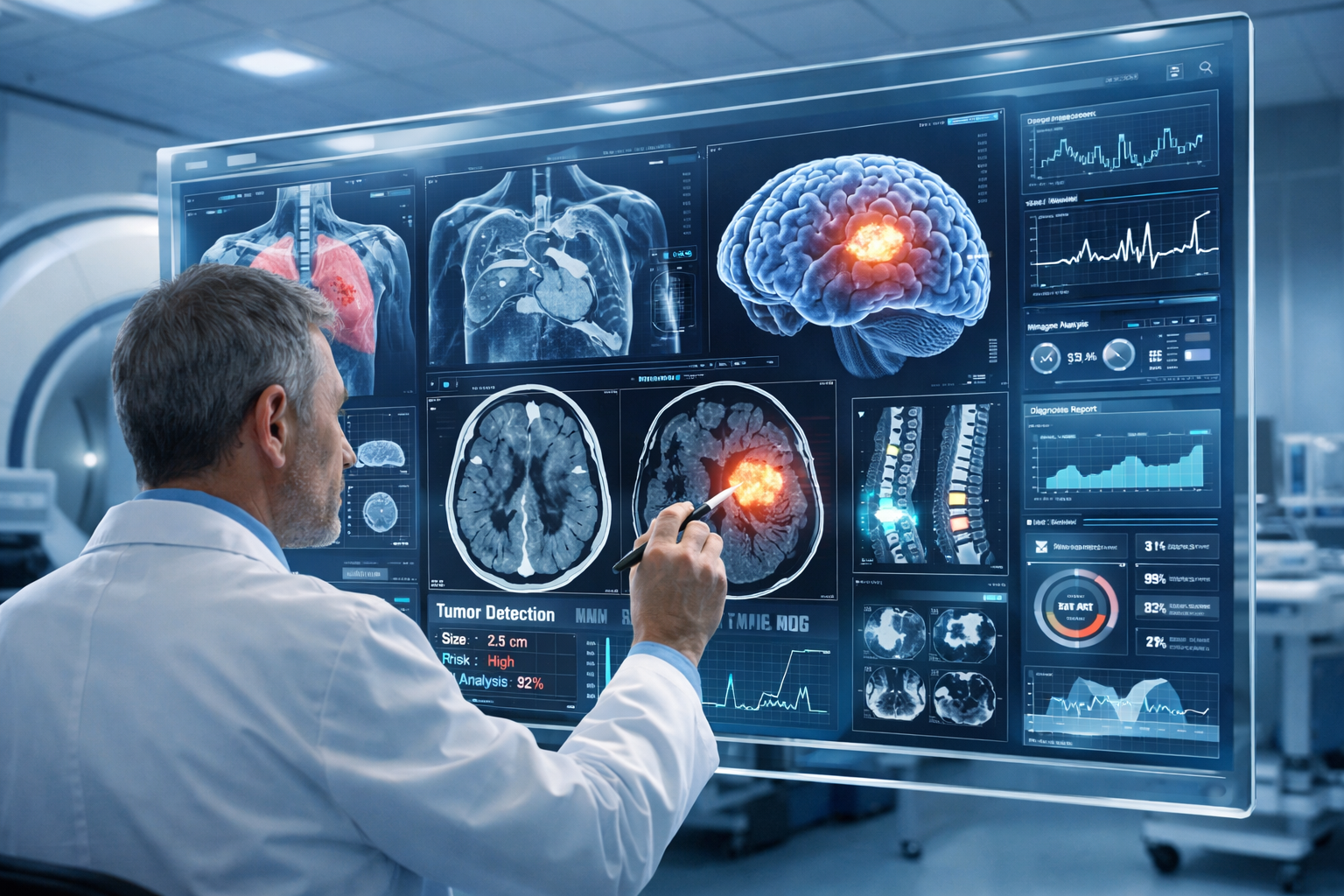
Medical technology is changing faster than ever , and one of the biggest changes is the use of artificial intelligence in radiology. Radiology artificial intelligence is the use of AI algorithms and machine learning to read medical images, find problems, and help doctors make decisions about diagnoses. This technology is changing the way traditional radiology works by making it more accurate, cutting down on human error, and making patient care more efficient.
Medical imaging is very important for finding diseases and keeping an eye on how well treatment is working. Radiologists use X-rays, CT scans, MRI scans, and ultrasounds to look inside the body. But figuring out what these pictures mean is a complicated process that can take a long time and be prone to mistakes. AI technologies in radiology are intended to help radiologists make accurate and timely diagnoses by quickly analyzing large amounts of imaging data and finding patterns that are not visible to the naked eye.
What is AI in radiology?
Radiology artificial intelligence is a computer-based method that uses algorithms to look at medical images. It uses computer vision, machine learning, deep learning, and neural networks to work. Machine learning lets AI systems learn from old imaging data, and deep learning helps them find complicated patterns in scans. These technologies let AI see small changes in tissue, spot early signs of disease, and even guess how conditions might change over time.
AI doesn’t replace radiologists like traditional methods do; it works with them. AI takes care of routine analysis so that radiologists can focus on hard cases that need expert judgment. Working together, AI and human experts improve the accuracy of diagnoses, speed up reporting times, and make sure patients have better outcomes.
How AI in Radiology Works
Radiology AI works by using a number of cutting-edge technologies. Machine learning systems acquire knowledge from thousands of labeled medical images, enabling them to identify features associated with specific conditions. Deep learning neural networks work like the brain, which lets them find small problems in imaging data. Computer vision lets AI “see” and understand pictures, and natural language processing (NLP) looks at radiology reports to connect the results with the patient’s history. When used together, these technologies make a powerful tool that can speed up and improve the accuracy of diagnoses.
Radiology AI Applications: Finding and Diagnosing Diseases
One of the most important uses of AI in radiology is finding diseases. AI algorithms can find tumors, broken bones, blood vessel problems, and diseases that get worse over time with outstanding accuracy. AI can discover early-stage lung nodules or small changes in breast tissue that might be missed in oncology. That makes it possible to act quickly. AI can also find strokes, brain bleeds, and musculoskeletal injuries, which helps doctors make diagnoses faster and more accurately.
Improving the flow of work
Radiology departments deal with a lot of images every day, and keeping track of all this data is hard. AI helps make workflows better by automating tasks that need to be done over and over, putting urgent cases first, and assisting with the creation of initial reports. That makes sure that radiologists only work on the most difficult cases, which makes the whole department run more smoothly. AI also helps with quality control by finding low-quality images or scans that need to be redone, which cuts down on mistakes and makes patients more comfortable.
Reconstructing and improving images
AI improves the quality of images and speeds up the reconstruction of MRI and CT scans. AI cuts down on scan times and makes diagnoses more accurate by making images clearer faster. Faster imaging is good for both patients and healthcare providers because it makes scheduling easier and improves the patient experience. Enhanced images also give radiologists more detailed information, which helps them accurately diagnose diseases.
Personalized medicine and predictive analytics
Radiology AI makes personalized care possible by looking at imaging data along with a patient’s medical history, lab results, and genetic information. AI can help doctors make customized treatment plans by predicting how a disease will progress and how well a treatment will work. AI can, for instance, assess the risk of heart disease or predict the spread of cancer, which lets doctors act before the disease spreads. AI-powered predictive analytics helps people get better results and lowers the cost of healthcare by stopping complications before they happen.
Advantages of AI in Radiology
There are many benefits to using artificial intelligence in radiology. First, it makes diagnoses more accurate by reducing human error and giving consistent results. Second, it speeds up the time it takes to report, which means that radiologists can provide patients with results faster. Third, it makes operations more efficient by automating tasks that are done every day and making workflows better. Fourth, it improves patient care by allowing for early detection and personalized treatment planning. AI helps radiologists make tough decisions, which lets them focus on cases that need human expertise.
Problems and Limitations of AI in Radiology
There are problems with using radiology artificial intelligence, even though the benefits are great. Data privacy and security are very important because medical imaging deals with private patient information. Healthcare facilities must make sure they follow the rules and keep patient information private. Another worry is algorithmic bias, which means that AI systems might have biases from the datasets they are trained on. It could cause them to work differently for different groups of people. It can also be hard to integrate with the infrastructure that hospitals already have, and staff need to be trained. Some radiologists may also be hesitant to use AI because they are afraid of losing their jobs or don’t trust the results that come from machines. To make sure that AI is used in a moral and useful way in clinical settings, these problems need to be fixed.
The Future of AI in Radiology
There is a lot of hope for the future of artificial intelligence in radiology. AI systems are expected to get better and better at finding rare diseases and small problems with more accuracy. AI analysis in real time during imaging tests will give doctors immediate diagnostic information, which will help them make decisions more quickly. Combining AI with wearable devices and remote monitoring systems could make it possible to check on a person’s health all the time and let healthcare professionals know when something is wrong. AI-powered teleradiology will also make advanced diagnostics available to areas that are far away or don’t have enough healthcare providers. That will help close gaps in global healthcare access.
Radiologists and AI need to work together to be successful in the future. Radiologists help create algorithms that are useful in the real world, give feedback to make them more accurate, and make sure they are used in an ethical way. Regulatory frameworks are changing to make sure that AI systems are safe, effective, and accountable. Ongoing education and training make sure that medical professionals can work well with AI technologies. Ethical issues like honesty, patient consent, and fair access are still very important when it comes to using AI responsibly.
Radiology AI in Medical Research
Artificial intelligence in radiology is changing the way doctors work and also helping medical research move forward. Researchers can find new disease markers, spot trends, and come up with new treatments through large-scale imaging analysis. AI speeds up clinical trials by quickly analyzing imaging endpoints, which cuts down on trial time and makes them more efficient. Genomics and precision medicine work together to help us understand complicated diseases better. This mix of AI and research could change healthcare in ways that go beyond radiology, affecting how we diagnose, treat, and prevent diseases.
The World Uses AI in Radiology
More and more people around the world are using artificial intelligence in radiology. AI is helping hospitals in developed countries improve their diagnostic abilities, and teleradiology powered by AI brings advanced imaging services to areas that are hard to reach. This technology helps make healthcare more equitable and makes sure that more people can get high-quality diagnostic tests. AI solutions will have a bigger effect on healthcare systems around the world as they become cheaper and easier to access. They will provide faster, more accurate, and more efficient care for patients.
Questions and Answers (FAQs)
What is AI in radiology, and how does it work?
Radiology AI is the use of computers to look at medical images. It uses machine learning and deep learning algorithms to find patterns and problems in X-rays, CT scans, MRIs, and other types of imaging. AI helps radiologists by making their analyses faster and more accurate.
Does AI in radiology take the place of human radiologists?
Radiology AI does not take the place of radiologists. It helps them by automating routine tasks, putting urgent cases first, and giving them diagnostic help. For making complex treatment and interpretation decisions, human expertise is still very important.
How precise is AI in radiology?
The quality of the training data and algorithms used to train radiology AI affects how accurate it is. In some imaging tasks, like finding lung nodules, breast cancer, or fractures, modern AI systems can match or beat human performance. Continuous improvement makes sure that things get more reliable over time.
Can AI in radiology look at all kinds of medical images?
Yes, AI can look at X-rays, CT scans, MRIs, ultrasounds, and PET scans. To make sure that abnormalities are found and understood correctly, specialized algorithms are made for each type of imaging.
What are the most important advantages of AI in radiology?
Radiology AI makes diagnoses more accurate, speeds up the process of interpreting images, improves patient care, and makes radiology departments run more smoothly. It also helps make healthcare more affordable by cutting down on unnecessary tests and making operations run more smoothly.
Are there any dangers that come with AI in radiology?
Possible risks are worries about data privacy, bias in algorithms, and problems with getting AI to work with current hospital systems. You can lower these risks by managing your data safely, using a variety of training datasets, following the rules, and being careful when you implement them.
What impact does AI have on the future of radiology?
AI is making it possible to do diagnostics, predictive analytics, and personalized treatment planning in real time. It is making medical imaging more accessible through teleradiology and wearable integration, and it is also helping radiologists provide faster and more accurate patient care.
Final Thoughts
Artificial intelligence in radiology is changing the field of medical imaging by combining the latest technology with human knowledge. It improves the accuracy of diagnoses, makes workflows more efficient, allows for personalized medicine, and leads to better patient outcomes. There are problems with data privacy, algorithmic bias, and integration, but the future of AI in radiology looks good. AI enables a smarter, faster, and more efficient healthcare system by fostering collaboration among radiologists, researchers, and technology developers and ensuring responsible and ethical use. Integrating AI into radiology marks a major step toward a future where medical imaging improves patient care worldwide.