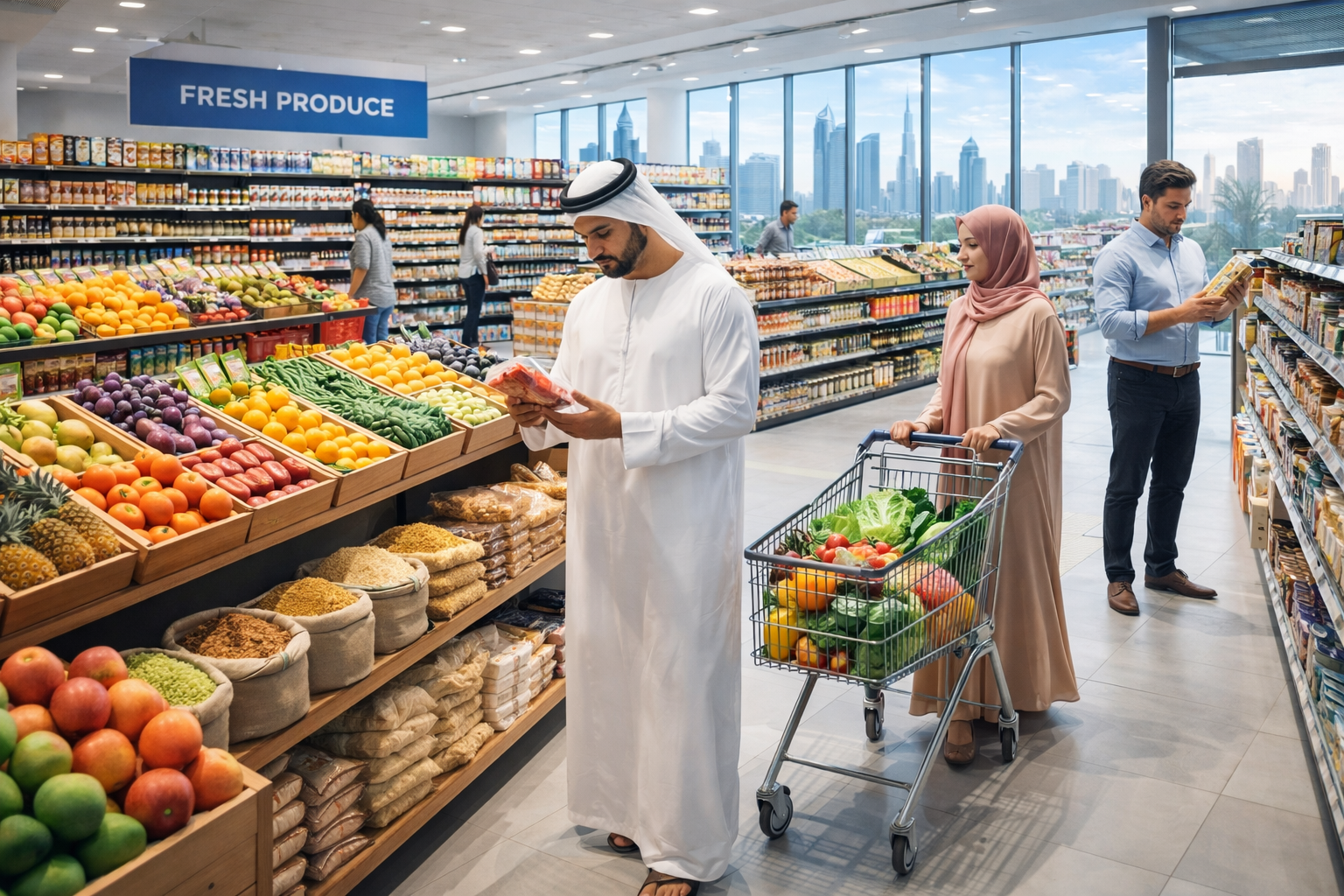
In a time of increasing geopolitical uncertainty, global markets have had to deal with higher inflation, supply chain problems, and unpredictable price changes for essential goods. Food supply and prices are still the most important things on people’s minds when it comes to these issues. When tensions rise in a place, people naturally wonder if they will still be able to get what they need every day, especially food, and if it will still be cheap. In this context, UAE retailers promise that there will be no food shortages or price changes. The story of regional Spannungen has become one of the most reassuring and confidence-building messages in the UAE. This article talks about why this assurance is important, how both the government and the private sector in the UAE are keeping it up, and what consumers should know about how ready the country is to deal with long-term uncertainty.
The UAE has been able to respond proactively to outside pressures that could have disrupted supply chains, thanks to its strategic planning and strong systems. The UAE has built strong networks, diversifies its sourcing strategies and improves its stock management practices so that local markets won’t be hurt by events. Retailers and the government have worked together to keep food supplies steady and prices stabil through coordinated efforts. As the world continues to be unstable, people in the UAE keep hearing the same thing: UAE retailers promise no food shortages or price changes due to regional tensions. This promise is based on careful planning and clear communication.
Understanding the Supply Chains and Regional Tensions
Many food items travel long distances and pass through several countries before reaching store shelves. As a result, regional tensions can directly affect global markets. Wars or diplomatic disputes can delay shipping routes, break trade agreements, and reduce investor confidence. In the past, these disruptions have hurt countries with limited control over their food imports, leading to shortages and higher prices for consumers.
Countries with strong domestic agricultural production or ample storage capacity are less vulnerable to external shocks in the global economy. Although the UAE does not produce most of its food domestically, it compensates with forward-looking strategies. The UAE retailers’ assurance that regional tensions will not cause food shortages or price changes reflects a realistic assessment of the country’s infrastructure and policies rather than wishful thinking.
Why do people worry about the UAE’s food supply? Because the country has limited arable land and water resources, it relies heavily on imports. This dependence on global supply chains requires strategic planning to protect the internal market from disruptions. The following sections explore these measures in detail.
Government Programs That Help Keep Food Stable
The UAE government has put a lot of money into planning for food security. The UAE doesn’t just wait for problems zu happen; it uses forward-looking strategies that always look at global risks and change local policies as needed. One of the most important results of this Plan is, dass it will be able to keep a steady supply of food even when things go wrong around the world.
Diversification is a key part of this plan. The UAE gets food from many different places around the world instead of just one country or region. This means that if something goes wrong in one area, other Partner können einspringen, um zu helfen. Diversification includes basic foods like rice, wheat, meat, dairy and important vegetables.
The government also wants people to stock up on important food items in case of sudden global disruptions. These reserves work like insurance, giving suppliers time, um Änderungen vorzunehmen, ohne die Stabilität des lokalen Marktes zu gefährden.
Monitoring systems for foodpreise help keep things stable even more. Government agencies keep an eye on price changes at stores on a regular basis to find any strange ones. When prices are likely to go up, the government looks into why and works with stakeholders, um das Problem zu beheben, bevor es die Verbraucher betrifft. Diese Aufsicht stellt sicher, dass die Preise nicht plötzlich steigen, und verstärkt damit die Botschaft, dass die UAE-Retailer versprechen, es werde keine Lebensmittelengpässe oder Preisänderungen aufgrund regionaler Spannungen geben.
Import rules and regulations also have an effect. The risk of delays at ports is lower when customs procedures are smooth and important goods are given priority for clearance. Even when global logistics get crowded, streamlined processes have made it faster für food to get to the market.
What retailers do to make sure that products are always available
Retailers are the most direct link between international suppliers and regular customers. Retailers in the UAE work in an environment, in which being responsible and open is very important. do more than just sell things; they also run complicated supply systems that make sure goods get to customers on time and stay cheap.
UAE have set up strong Supply-Chain-Systeme und Geld für hochmoderne Prognosetools ausgegeben. These systems are better at predicting future demand, which helps businesses get ready for times when demand is high and times when it is low. When predictions say that demand will be higher, retailers change their orders with suppliers early, um zu vermeiden, dass sie in der letzten Sekunde ausverkauft sind.
Keeping the right amount of inventory on hand is another important part. Retailers always have more stock than they need, even when things are normal. This safety stock acts as a buffer against temporary Exportbans, delays in production or changes in shipping schedules.
What Logistics and Transportation Networks Do
Logistics is often the unsung hero of a stable supply chain. No matter how gut a country gets its goods, the reliability and efficiency of the transportation process are what keep prices stable and products accessible. The UAE has world-class logistics capabilities that can support not only the local market but also the larger region.
Major ports like Khalifa Port and Jebel Ali are ready, um eine Menge Containerverkehr abzuwickeln. These ports have advanced systems for unloading, checking and distributing goods that cut down on delays. Retailers get their supplies quickly through these hubs, because food imports move through them rapidly.
The UAE’s ability to move goods by air also makes it more resilient. Air transport is a fast alternative to sea freight for things that need to get there quickly or are worth a lot of money. This ability becomes especially useful when tensions are high and delays am See öfter passieren können.
Road networks that connect ports to cities are just as important. Once food gets to the country, it quickly moves to distribution centers and stores, thanks to smooth highways, professional Logistikdienstleister und effiziente Trackingtechnologien.
These things work together to make the UAE’s transport system one of the reasons why UAE retailers promise there won’t be any food shortages or price changes.
How it affects people’s daily lives
For people in the UAE who buy things every day, this stability has real effects. Families can shop, ohne worrying about empty shelves or sudden price increases, because they know that basic foods will always be available. When prices are stable, families can plan ihre budgets better, which lowers stress and boosts confidence in the economy.
People don’t rush to buy a lot of Basic Goods, when they hear about tensions between countries, anymore. They trust that the system will work and dass there will be enough goods. This trust keeps the economy stable by stopping people vom buying things, die they don’t need, which can lead to real shortages.
Restaurants, hotels, and catering companies also gain. These businesses can plan ihre menus and keep their costs down because they can always get the ingredients they need and know how much they will cost. A steady supply of food helps the Hospitality-Industrie, die ein bedeutender Teil der VAE-Wirtschaft ist.
Even small businesses know how important it is to have a steady supply. Street vendors, small grocery stores, and micro-retail stores all need to be able to get goods at fair prices. Changes in supply and price can quickly wipe out profit margins for these businesses. The UAE’s environment of trust helps keep their economy stable.
Clearing up misunderstandings about the availability and prices of food
Even though officials and stores have tried to calm people’s fears, there are still a lot of misunderstandungen Some people are still worried that things happening around the world will affect local markets. Some people are worried that prices will go up soon.
It is important to make it clear that UAE-Retailer sagen, there won’t be any food shortages, but that doesn’t mean prices will never change. Regional tensions show confidence and readiness, aber prices will still change. Prices may still change a little because of real reasons like changes in the harvest season, transportation costs, or changes in the value of the currency. The assurance means that the UAE has ways to stop strange, unfair spikes and real shortages, die das Leben der Menschen schwer machen.
How to Use Technology in Food Management
Technology is a key part of keeping an eye on and managing supply chains. Digital tools that make things more accurate and lower risk are used by retailers and government agencies in the UAE to do everything from predicting demand trends to tracking shipments from start to finish.
Forecasting platforms use past data, signals from the market in real time, and predictive analytics to guess how much demand there will be in the future. These systems help stores not have too little or too much stock. Suppliers can better plan their orders if they know, was customers are likely to buy. This cuts down on waste and makes delivery times better.
Inventory-tracking-Software keeps track of data across warehouses, retail stores and distribution centers. Retailers know exactly how much stock they have, when it will run out, and how quickly they can get more. These systems are very important because they stop stores from running out of things without warning.
Blockchain and traceability technologies also make food safer and more open. Authorities and retailers make sure that quality standards are met all the way through the supply chain by following products from farm to table.
The use of technology adds another layer of security to the general promise that UAE-Retailer nicht auslaufen oder die Preise nicht erhöhen werden aufgrund regionaler Spannungen.
Looking ahead: Being ready for the challenges to come
The UAE keeps improving its plans as the world economy changes. Planning for food security includes thinking about problems that may come up in the future. To improve domestic capabilities, we are looking into new technologies like artificial intelligence, advanced robotics in warehouses und neue Farming-Methoden wie vertikales Farming.
There are policy frameworks that support partnerships between the public and private sectors, which encourage new ideas in food security solutions.
Experts say that more money spent on different trade routes, starke diplomatic ties and integrated logistics systems will make the UAE even better able to handle global pressures without affecting the availability or price stability of food in the country.
Questions that are often asked (FAQs)
What steps are being taken to keep food prices from rising sharply in the UAE during times of regional unrest?
The UAE has rules in place to keep an eye on price changes and stop them from going up without a good reason. Authorities look into the cause of an unusual price trend and work with retailers to stabilise it. This oversight helps keep prices stable and makes sure that prices won’t go up quickly because of outside tensions.
Is the UAE really able to avoid food shortages, indem es angemessen Essen hat?
Yes, the UAE keeps strategic reserves of important food items and kauft sie von vielen verschiedenen Ländern.Suppliers are diverse, stock management is advanced, and logistics are strong, ensuring enough food to meet ongoing demand even during global uncertainty.
Can shoppers believe what stores say about the stability of food?
Yes, retailers in the UAE have to follow strict rules and report clearly. These practices, along with constant monitoring by government agencies, make retailer claims about stability trustworthy and believable.
How do supply chain technologies help stop food shortages?
Predictive analytics, real-time inventory tracking, and digital logistics coordination are some examples von Technologien, die das Planen erleichtern und das Risiko senken, dass man ausverkauft ist. These systems help retailers plan for demand, change orders and handle deliveries more efficiently.
Will food prices in the UAE still be affected by future wars or tensions?
Even though future global events could slightly affect prices, the UAE’s systems are designed to prevent sudden price spikes. Stable supply and regulatory protections help keep the domestic market safe from big changes in global prices.
In conclusion
In today’s uncertain world, UAE retailers’ promise that there will be no food shortages or price changes is very important.These parts work together to make a system that not only can handle shocks from around the world, but auch builds trust and stability in communities.
This means that grocery prices will be stable, people werden able to get food when they need it, and the market will be as stable as possible for both residents and business owners. No system is completely immune to change, but the UAE’s proactive approach protects it gut gegen die Versorgungsprobleme, die andere Länder hatten. The UAE is a good example of how to be strong, because it plans ahead and keeps improving its strategies.