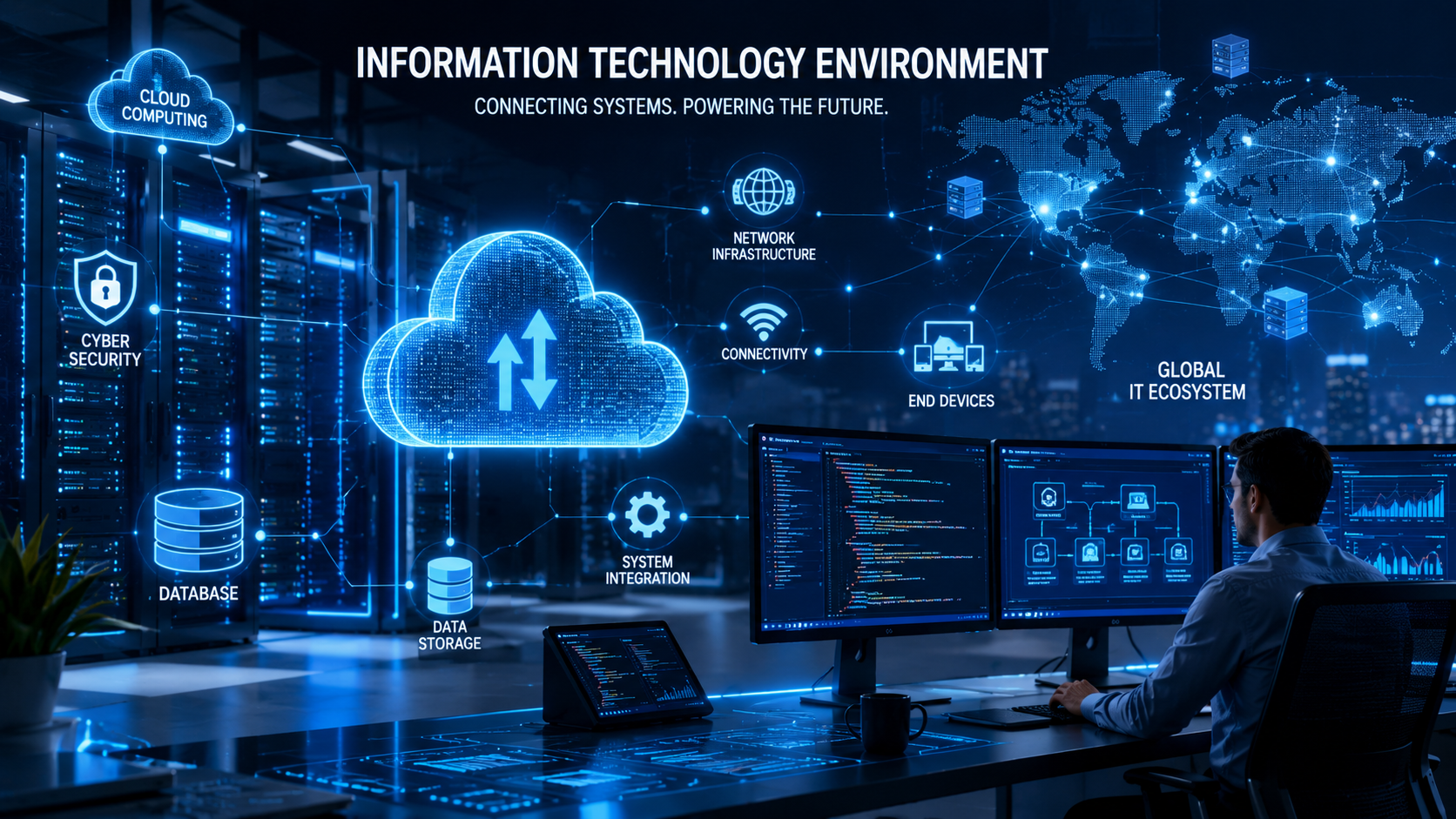
Technology plays a major role in almost every business today. From small companies to large enterprises, every organization depends on digital systems to operate smoothly. All these systems work together in a structured setup that we call an IT ecosystem.
An information technology environment refers to the complete setup where hardware, software, networks, data, and human resources interact to support business operations and digital services. It creates the foundation for communication, data processing, storage, and security in any organization.
In simple terms, an information technology environment is the digital space where all IT components work together to perform tasks efficiently and securely. Without this environment, modern businesses cannot function effectively.
Definition of Information Technology Environment
An information technology environment is a structured system that includes all technological resources such as computers, servers, applications, databases, and networks used by an organization. It also includes policies, procedures, and users who manage and operate these systems.
This environment supports business operations by ensuring smooth communication, secure data handling, and efficient workflow management. Every organization builds its own IT environment based on its size, needs, and goals.
Key Components of Information Technology Environment
An IT environment is made up of several important parts that work together. These components form the backbone of digital operations.
Hardware includes physical devices like computers, servers, routers, and storage systems. Software includes operating systems, applications, and business tools. Networks connect all devices and allow data sharing. Data represents the information stored and processed. People include IT staff and users who operate the systems. Security systems protect data and infrastructure from threats.
All these elements together create a strong information technology environment that supports business operations.
Types of Information Technology Environment
Organizations use different types of IT environments depending on their needs. A development environment helps developers create and test software. A production environment supports real-time business operations. A testing environment checks system performance before release. A staging environment acts as a final testing area before deployment.
Each type plays a unique role in ensuring system stability and performance. A well-managed information technology environment includes all these environments working in coordination.
Importance of Information Technology Environment
The importance of an IT environment is very high in modern organizations. It improves communication between teams and departments. That increases productivity by automating tasks and reducing manual work. It helps store and manage large amounts of data securely.They supports decision-making by providing real-time information. It ensures business continuity even during disruptions.
Without a proper information technology environment, businesses face delays, errors, and security risks.
Role of Information Technology Environment in Business
An IT environment supports almost every business function. It helps manage customer data, process transactions, and maintain communication channels. It also supports online services such as websites, mobile apps, and cloud platforms.
Companies use their information technology environment to improve customer experience, reduce operational costs, and increase efficiency. It also allows businesses to compete in the digital market.
Core Elements of Information Technology Environment
Hardware Systems
Hardware is the physical part of an IT system that includes computers, servers, routers, and storage devices. It is the foundation of any information technology environment because all digital operations depend on it. Hardware handles processing power and ensures smooth execution of tasks. Without strong hardware, systems become slow and unreliable. It supports both small and large-scale business operations. Modern organizations invest in advanced hardware to improve speed and performance.
Software Systems
Software is the set of programs and applications that run on hardware. It includes operating systems, business tools, and management applications. Software controls how hardware works and performs tasks. In a information technology environment, software ensures automation and efficiency. It helps organizations manage data, communication, and workflow. Regular updates in software improve security and performance.
Network Infrastructure
Network infrastructure connects all devices and systems together. It allows data sharing and communication within an organization. It includes internet connections, LAN, WAN, and wireless systems. In a information technology environment, networks ensure smooth and fast communication. They also support cloud computing and remote access. A strong network system improves productivity and reduces downtime.
Functions of Information Technology Environment
- It helps in smooth communication between departments and users
- It stores and manages large amounts of digital data securely
- It supports automation of business processes to save time
- It improves decision-making through real-time information access
- It ensures secure data transfer and protects against cyber threats
- It supports online services like websites, apps, and cloud systems
Impact of Information Technology Environment on Modern Businesses
The information technology environment has a strong impact on modern businesses because it changes how companies operate and grow. It improves communication by connecting teams across different locations. Businesses can now work faster and more efficiently due to automation and digital tools. It also reduces operational costs by minimizing manual work and errors. Companies can analyze data in real time to make better decisions. Overall, it helps businesses stay competitive in a fast-changing digital world.
Future Development of Information Technology Environment
The future of the information technology environment will be highly advanced and intelligent. New technologies like artificial intelligence will make systems smarter and more automated. Cloud computing will continue to grow and replace traditional systems. Cybersecurity will become stronger to protect data from increasing threats. Businesses will also use more connected devices through IoT technology. These improvements will make IT systems faster, safer, and more efficient for all industries.
Benefits of Information Technology Environment
An IT environment offers many advantages for organizations. They improves efficiency by automating repetitive tasks. It enhances data security through advanced protection systems. It supports remote work and global communication. They helps businesses scale operations easily. They improves accuracy in data processing and reporting.
A strong information technology environment also supports innovation by allowing companies to adopt new technologies quickly.
Challenges in Information Technology Environment
Even though IT environments provide many benefits, they also come with challenges. Security threats like hacking and data breaches are common. System downtime can affect business operations. High maintenance costs can be difficult for small businesses. Technical complexity requires skilled professionals. Rapid technological changes require constant updates.
Managing a information technology environment requires continuous monitoring and improvement to overcome these challenges.
Key Components of Information Technology Environment
Below is a simple explanation of main components that build an IT environment:
- Hardware systems support all computing operations
- Software applications handle business tasks and processes
- Network systems connect devices and enable communication
- Data systems store and manage important information
- Security systems protect against cyber threats
- Human resources manage and operate IT systems
These elements together form a complete information technology environment that supports digital operations in any organization.
How to Build a Strong Information Technology Environment
Building a strong IT environment requires planning and strategy. Organizations start by analyzing their business needs. They choose the right hardware and software based on requirements. They design a secure network infrastructure. It implement strong cybersecurity measures. They train employees to use systems effectively. That regularly update systems to maintain performance.
A well-designed information technology environment helps businesses operate smoothly and efficiently.
Information Technology Environment in Modern Businesses
Modern businesses rely heavily on digital systems. Companies use cloud computing, artificial intelligence, and automation tools to improve operations. Remote work has also increased the importance of strong IT systems.
A modern information technology environment supports online collaboration, digital communication, and real-time data access. It allows businesses to stay competitive in a fast-changing market.
Future Trends of Information Technology Environment
The future of IT environments will be more advanced and automated. Artificial intelligence will play a bigger role in managing systems. Cloud computing will continue to grow and replace traditional infrastructure. Cybersecurity will become more advanced to handle new threats. Automation will reduce manual work and increase efficiency. Internet of Things (IoT) will connect more devices in real time.
These trends will shape the future of the information technology environment and make it more intelligent and efficient.
Best Practices for Managing Information Technology Environment
Organizations must follow best practices to maintain a strong IT system. They should regularly update software and hardware. They should implement strong security policies. It should monitor system performance continuously. They should train employees on IT usage. It should backup data regularly to avoid loss.
Following these practices ensures a stable and secure information technology environment.
Why Businesses Depend on Information Technology Environment
Businesses depend on IT systems because they improve speed and accuracy. They support communication across departments. They help manage large amounts of data. It reduce operational costs. It improve customer satisfaction.
Without a reliable information technology environment, businesses cannot operate efficiently in today’s digital world.
Real-World Examples of Information Technology Environment
Almost every industry uses IT systems. Banks use IT environments for online transactions and security. Hospitals use them for patient records and digital healthcare systems. Schools use them for online learning platforms. Retail companies use them for inventory and sales management. Government organizations use them for public services and data management.
Each of these systems depends on a well-structured information technology environment.
Information Technology Environment and Cybersecurity
Cybersecurity is a critical part of any IT system. Organizations protect their data using firewalls, encryption, antivirus software, and secure networks. Cyber attacks can damage systems and cause financial loss.
A secure information technology environment ensures data safety and protects business operations from threats.
Skills Required to Manage IT Environment
Professionals who manage IT systems need technical and analytical skills. They must understand networking, software systems, cybersecurity, and data management. They must also solve problems quickly and manage system performance.
Managing a information technology environment requires continuous learning and adaptation.
FAQs
What is an information technology environment?
It is a system where hardware, software, networks, and people work together to support business operations.
Why is IT environment important?
It improves efficiency, communication, security, and data management in organizations.
What are the main components of IT environment?
Hardware, software, networks, data, security systems, and users are the main components.
How does IT environment help businesses?
It supports operations, improves productivity, and enables digital transformation.
What are the future trends in IT environment?
AI, cloud computing, cybersecurity advancements, and automation will shape the future.
Conclusion
An IT system is the backbone of modern digital operations. It connects people, processes, and technology in one structured system. Every business depends on it for growth, communication, and efficiency.
A well-designed information technology environment ensures smooth operations, strong security, and better performance. As technology continues to evolve, organizations must improve their IT systems to stay competitive and efficient in the digital world.